
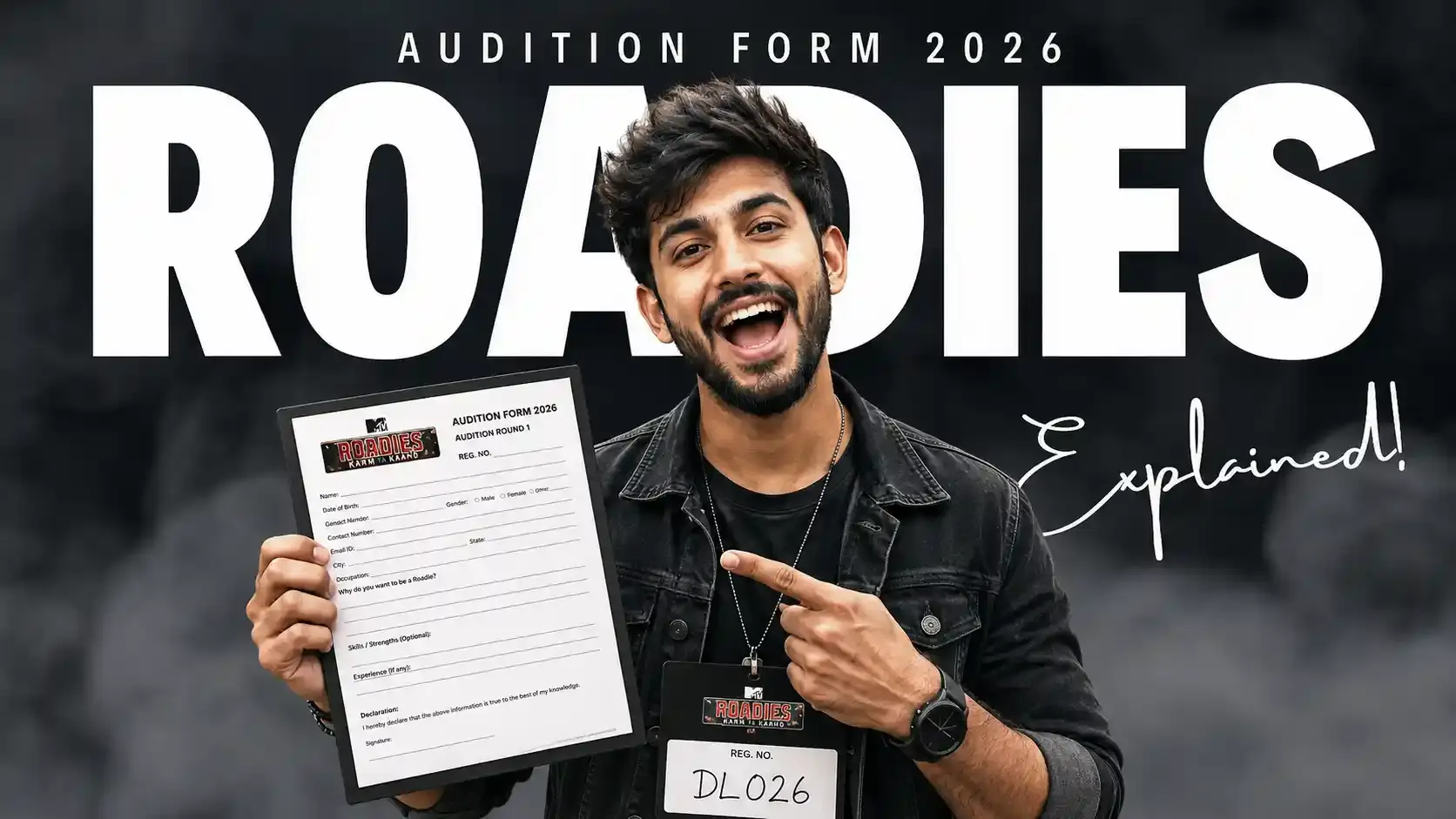
MTV Roadies has built two decades of its audition rounds around one core idea: questions designed to reveal character under pressure, not test general knowledge. Across the application form, group discussions, and the in-person panel interview, the questions cluster into a few recognizable categories — self-awareness, moral dilemmas, provocative opinions, and on-the-spot physical or improvised challenges.
How is the Roadies audition process structured?
Before questions even come from a panel, most seasons follow a three-stage funnel:
- Online application — a written form plus a self-introduction video.
- Group Discussion (GD) — a shortlisted batch of roughly 15–20 candidates debate an assigned topic while casting staff observe.
- Personal Interview (PI) — the final and most-cited-as-brutal round, where candidates face the judging panel directly.
Each stage uses a different style of question, which is why "what does Roadies ask" doesn't have one single answer — it depends which round you're talking about.
Why does the panel ask questions this way?
It helps to be clear about what the panel's job actually is, because it explains almost every strange question in the room. They are not hiring for a role or assessing merit in the way an interview normally does. They are casting a television season that has to hold attention for months, which means they need people who react in interesting ways when things go wrong.
That reframes the whole exercise. A question that seems rude or irrelevant is usually a probe for one specific thing: what you do when you're uncomfortable. A candidate who is impressive on paper but flat under pressure is worse casting than someone less polished who stays recognisably themselves while being poked at. This is also why the questions are rarely answerable "correctly" — there's no answer key, because the answer isn't the data being collected.
It's worth saying plainly that this cuts both ways. A process built to find people who react well to provocation is, by design, uncomfortable to sit through. Going in knowing that the discomfort is the mechanism rather than a sign it's going badly is most of the preparation.
What does the application form ask?
Written application forms from past seasons give the clearest look at how the show frames its opening questions. One season's form, for instance, asked candidates to weigh in on whether success comes from performance or politics, to name the one thing they're best at, to describe the most adventurous thing they'd ever done, and to take a position on a socially charged current-affairs topic of that year. It closed with a deliberately uncomfortable prompt: explain why you should not be selected.
That last question is a pattern that's persisted in spirit across seasons — the show consistently uses at least one question designed to make candidates argue against themselves, since how someone handles self-criticism reveals more than a rehearsed pitch does.
What happens in the group discussion round?
GD rounds don't ask individual questions so much as drop a topic and watch how each candidate behaves in a crowd — do they dominate, listen, build on others' points, or get drowned out. Topics tend to be pulled from whatever's current and mildly divisive at the time of casting: social movements, policy debates, or gender and relationship norms. The content changes every year; the format — assign a hot topic, observe the group dynamic — has stayed constant.
Because the topic is interchangeable, preparing the topic is the wrong preparation. What's being assessed is narrower than it looks:
- Do you enter the conversation at all? In a batch of 15 to 20 people competing to be noticed, silence is the most common way to be forgotten.
- Can you make a point without shouting over someone? Volume gets you noticed for the wrong reason. Candidates who cut everyone off tend to read as difficult rather than strong.
- Do you listen? Referencing what someone else said and building on it is disproportionately effective, because almost nobody does it.
- Can you hold a position when the room disagrees? Same trait the interview tests, observed in a group instead of one-on-one.
The practical version: say something early, say it once clearly, and don't treat the other candidates as the opposition. The people evaluating you are on the sidelines, not in the debate.
What does the personal interview ask?
This is where Roadies' reputation for "tricky" and confrontational questioning comes from most directly. Recurring themes across seasons include:
- Self-rating and self-awareness — being asked to honestly size up your own strengths, weaknesses, and worth as a candidate.
- Personal and sometimes uncomfortably intimate questions — about relationships, past experiences, or private choices, asked bluntly and often without warning.
- Moral and hypothetical dilemmas — scenario-based questions meant to expose values rather than facts.
- Motivation checks — direct questions about whether you're there for the show's format itself or simply for fame, and how honestly you can answer that.
- Physical mimicry or improvised tasks — some seasons have had panelists ask candidates to perform something on the spot (impressions, physical stunts, quick displays of a skill) as a way to test composure as much as talent.
Two things past contestants and casting-focused write-ups consistently point out: the panel often disagrees with or interrupts an answer deliberately, purely to see whether the candidate stays composed or gets rattled, and a well-told personal story — genuine or exaggerated — has historically had an outsized effect on how memorable a candidate becomes. That second point cuts both ways: the franchise has also had cases where a contestant's dramatic backstory was later found to be fabricated and was called out publicly once discovered, which is a reminder that panels do eventually fact-check the more theatrical stories.
What are these questions actually testing?
Mapping each style of question to the trait behind it makes the round far less mysterious:
| The question | What it's really measuring |
|---|---|
| Rate yourself / name your weakness | Whether your self-image survives contact with honesty |
| Why should we pick you over the next person | Whether you have a specific reason to be there |
| Why should we not pick you | Whether you can be self-critical without collapsing |
| A blunt personal question | How you set a boundary while staying engaged |
| A moral or hypothetical dilemma | What you actually value, not what you know |
| Interrupting or disagreeing with you | Composure, and whether your position was real |
| Perform something right now | How you handle being put on the spot unprepared |
Read down that right-hand column and the pattern is obvious: almost every question is measuring the same small set of things from different angles. Which is good news for preparation, because you don't need answers to a hundred possible questions — you need to be settled on a handful of things about yourself.
How should you handle a provocative question?
Some version of a deliberately uncomfortable question is close to guaranteed. A few approaches that hold up better than others:
Answer the question that was asked. Deflecting into a prepared speech is the most visible thing you can do in that room. Even a short, direct answer beats a polished non-answer.
You're allowed to decline. If a question crosses a line for you, saying so calmly and without hostility is a legitimate response, and it demonstrates the exact composure being tested. Panicking or getting aggressive doesn't.
Don't argue with the premise unless you mean it. If a panelist mischaracterises you, correcting them once, plainly, is fine. Doing it three times reads as defensive.
Let a pause exist. Taking two seconds before answering a hard question looks like thinking. Filling the silence reflexively looks like nerves.
Don't try to win. There's no winning an exchange with the panel, and candidates who treat it as combat usually come off worse than those who treat it as a conversation they're not in control of.
What should you prepare for this season?
With Roadies REBIRTH auditions confirmed for September 2026 across Delhi, Chandigarh, Kolkata, and Pune, the exact questions this year's panel uses will only become clear once ground auditions start. But the underlying pattern is a safe bet to prepare for:
- Have an honest answer ready for "why should we pick you" and "why shouldn't we."
- Expect at least one question designed to catch you off guard rather than to be answered "correctly."
- Don't over-rehearse a story — panels have a long history of probing inconsistencies.
- Composure under interruption tends to matter more than the content of any single answer.
For the bigger picture on this season's announcement, eligibility, and application steps, see our full REBIRTH audition guide, and for what's confirmed about the new season overall, our Roadies REBIRTH overview.